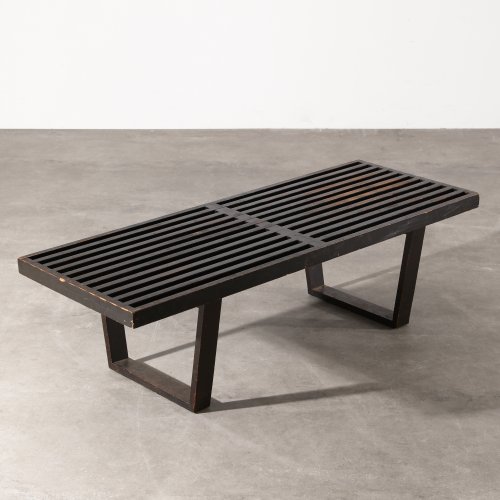
Biography
Architect, theorist, and furniture designer George Nelson is considered one of the defining figures of American Mid-Century Modern. His work exemplifies the functionalist yet humanistic design approach of postwar modernism in the United States. Over a career spanning more than five decades, Nelson acted not only as a designer but also as an influential mediator between architecture, industrial design, and design theory.
His early career is closely linked to elite academic training: after completing his studies at Yale University, Nelson received the prestigious Rome Prize, which enabled him to spend the years 1932 to 1934 at the American Academy in Rome. This period was formative for his later conception of design as an interdisciplinary process. Upon his return, he quickly established himself as a design writer and became an editor at the magazines 'Fortune' and 'Architectural Forum' in 1935. In articles for 'Pencil Points', he analyzed the avant-garde of modern architecture and contributed significantly to the reception of European modernism in the United States.
A decisive step toward furniture design was marked by his theoretical and practical exploration of the concept of modular living. With the so-called “Storagewall,” Nelson developed a systemic furniture concept that is considered an early precursor to today’s modular furniture systems. He published this idea in 1945 together with Henry Wright in the book 'Tomorrow’s House', which promoted the vision of a rationalized, flexibly configurable living space. The media response—particularly an article in' Life' Magazine—brought him to the attention of the furniture industry.
Subsequently, Nelson was hired by D. J. De Pree, the founder of Herman Miller, as Design Director—a position he held from 1945 to 1972. In this role, he functioned less as a traditional designer of individual objects and more as a curator and catalyst for a new design culture. Nelson viewed design as a collaborative process and brought together some of the most significant designers of the modern era, including Charles Eames and Ray Eames, Isamu Noguchi, and Alexander Girard. His collaboration with the Eameses, in particular, contributed decisively to Herman Miller’s international appeal. At the same time, Nelson founded his own studio, George Nelson & Associates Inc., which served as an interdisciplinary platform for product, graphic, and exhibition design. His close collaborators included Irving Harper, who made a significant contribution to the formal development of iconic designs, as well as other designers and architects who collectively pursued an experimental and innovation-driven design approach.
Nelson’s furniture design is characterized by a clear functional logic, industrial manufacturing concepts, and a playful, often biomorphic design language. His work reflects central principles of Modernism such as “form follows function,” yet expanded to include emotional and communicative aspects of design. Among his best-known designs are the Marshmallow Sofa (1952), an ironic play on mass production and Pop aesthetics; the sculptural Coconut Chair (1956); and the Kangaroo Chair (1956), which combines lightness and structural clarity.
Another milestone is the “Action Office I” office system (1964–65), considered one of the first open-plan office concepts and marking the transition from rigid work structures to flexible, ergonomically oriented work environments. This system exemplifies Nelson’s holistic approach to design, which integrates organization, function, and human needs. The roll-top desk he designed was also honored with the Alcoa Industrial Design Award and underscores his commitment to harmonizing aesthetics and practicality.
In addition to furniture, Nelson also designed clocks, lighting, and exhibition concepts that captivate with their graphic clarity and innovative use of materials. His body of work has had a lasting impact on the development of American design in the 20th century and continues to serve as a benchmark for modern, systematic, and user-oriented design.
Objects by George Nelson
-
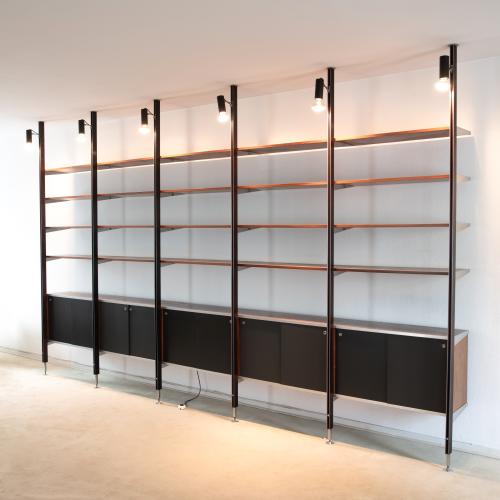
George Nelson Herman Miller, Zeeland
Shelving system model Comprehensive Shelf System CSS
Estimate: 5,000 € - 7,000 €
-
Sold
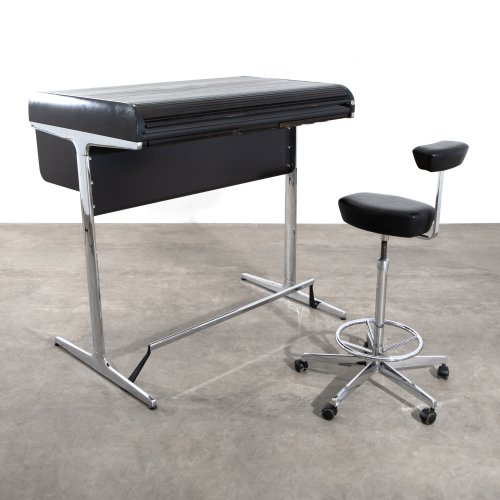
George Nelson Herman Miller
Action Office Rolltop Standing Desk + Work Chair Model Perch
Hammer Price: 1,000 €
-
Sold