Biography
“Less is more.” With this guiding principle and his minimalist architectural style, Ludwig Mies van der Rohe became one of the most significant architects of the modern era. Born in 1886 as Ludwig Mies in Aachen, he grew up in modest circumstances. His father was a stonemason, and so Mies was exposed to craftsmanship and architectural techniques from an early age. After training as a bricklayer, he began his career working for various architects in Aachen, where he impressed them with his talent for drawing.
In 1905, Mies moved to Berlin, where he worked for the first time as a furniture designer in Bruno Paul’s studio. It was a pivotal phase during which he shifted from traditional architectural styles toward modern architecture. Among his first independent projects was the design of the single-family home “Haus Riehl,” which was built in Babelsberg in 1907. In 1908, Mies took a decisive step in his early career and began collaborating with the renowned architect Peter Behrens. By 1911, he had familiarized himself with the principles of industrial design, mass production, and the use of modern materials such as steel and glass. During his time with Behrens, he also met other young architects, including Walter Gropius and Le Corbusier, who would also go on to shape the 20th century.
In the early 1920s, Mies—who had by then added “van der Rohe” to his surname—became increasingly involved in the avant-garde architectural discourse in Berlin and designed various projects for office buildings, country houses, and skyscrapers. One project that was never realized was the design for a high-rise on Friedrichstraße. This envisioned a slender, fully glazed high-rise supported by a steel structure. The design is now considered visionary and marks the transition to a new architectural language. In 1922, he joined the so-called “November Group,” an artists’ association that advocated for a radical renewal of art and architecture after World War I. Until 1925, he organized the group’s architectural contributions to the annual Great Berlin Art Exhibition.
Following the construction of “Haus Wolf” in 1926, van der Rohe was invited by the city of Stuttgart to organize the Werkbund exhibition “Die Wohnung.” It was an exhibition of houses designed by the leading modern architects of the time. Van der Rohe himself designed an apartment block there that demonstrated his minimalist principles and his use of reinforced concrete. The success of the Stuttgart Werkbund exhibition enabled him to head the German Pavilion in Barcelona in 1929, for which he created the “Barcelona Chair” in collaboration with designer Lilly Reich and others. In 1930, van der Rohe became director of the Bauhaus in Dessau and Berlin. He attempted to lead the school through difficult political times until 1933, before it was closed by the Nazis.
In 1938, he emigrated to the United States and opened his own architectural firm in Chicago. He became head of the architecture department at the Illinois Institute of Technology and designed its campus. During his time in the U.S., he further developed his concept of open, flexible spaces. One of his most famous residential projects in the U.S. is the ‘Farnsworth House,’ a minimalist country house on the Foy River. It is an outstanding example of van der Rohe’s concept of fluid space and is considered the epitome of the “less is more” philosophy. His clean and functional designs have long shaped the appearance of many American cities in the mid-20th century. The ‘Seagram Building’ in New York City and the ‘Lake Shore Drive Apartments’ are also considered his most iconic projects.
Van der Rohe continued to work well into old age and remained productive even in the late 1960s. He received numerous awards, including the Gold Medal from the American Institute of Architects in 1963. His conviction that architecture should be limited to the essentials and emphasize the integrity of materials continues to influence generations of architects to this day.
Objects by Ludwig Mies van der Rohe
-
Sold
-
Sold
-
Sold
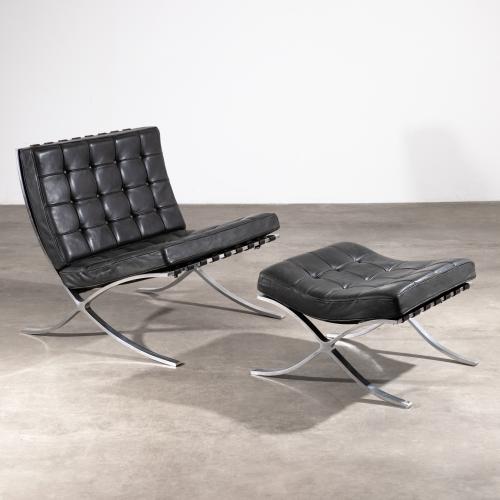
Ludwig Mies van der Rohe Knoll International
Lounge Chair model Barcelona with ottoman
Hammer Price: 1,800 €
-
Sold
-
Sold
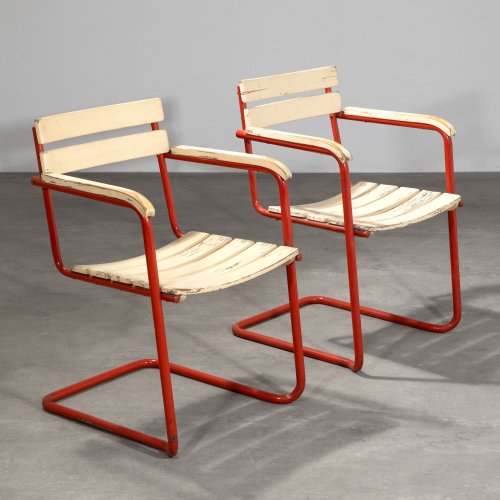
Ludwig Mies van der Rohe (prrobably) Thonet
2 cantilever garden chairs model B 34 g
Hammer Price: 1,500 €
-
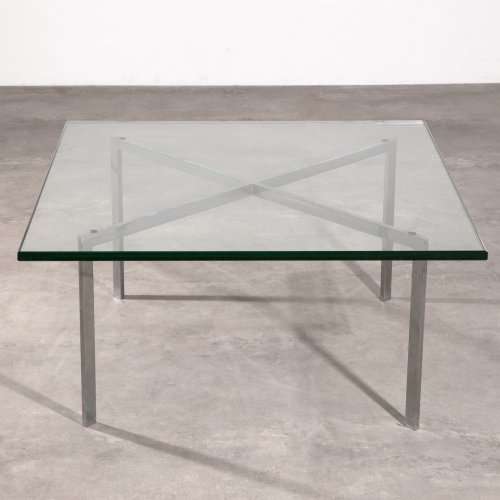
Ludwig Mies van der Rohe Knoll International
Side table / sofa table model Barcelona
Estimate: 500 € - 1,000 €
Unsold lot
-
Sold
-
Sold

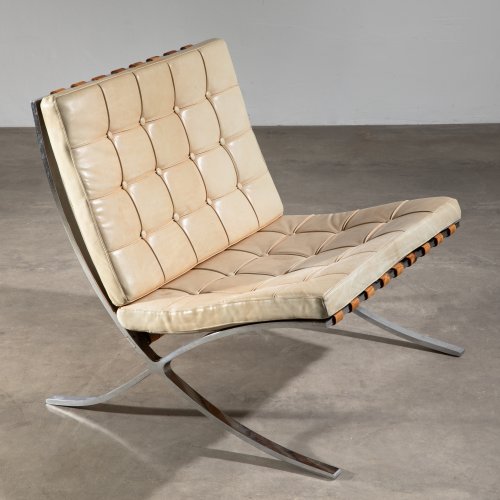
Ludwig Mies van der Rohe Knoll International
Lounge chair model Barcelona + ottoman
Hammer Price: 2,600 €
-
Sold